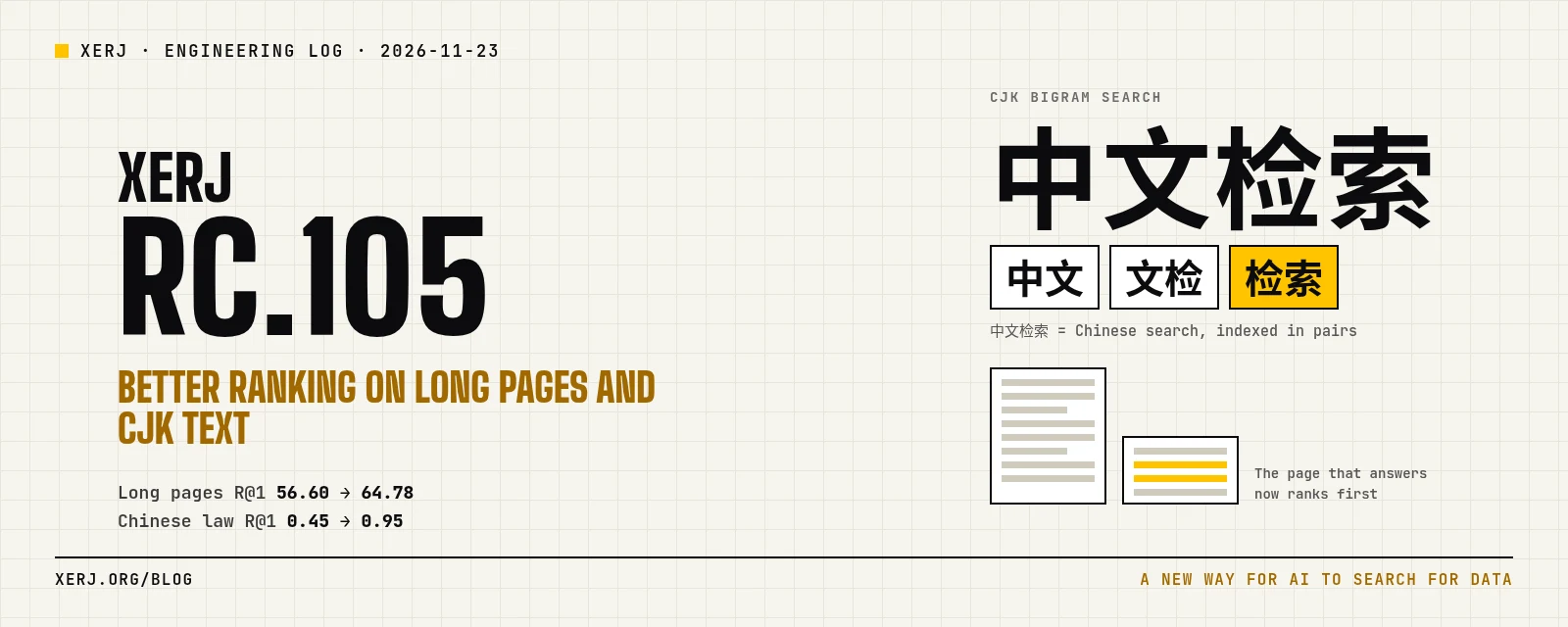
XERJ RC.105 (2026):
BETTER RANKING ON LONG PAGES AND CJK TEXT.
rc.105 is about finding the right passage. A long page no longer outranks the page that answers your question. Chinese text is searched in a way that fits the language. A top-10 over a field with more than 100,000 distinct values comes back with exact counts. Hybrid search reads less, and a merge holds less in memory.
Thank you. Many of these changes started with a report, a benchmark or a pull request from the community. You will find every name below. XERJ is a new way for AI to search for data, and it also speaks the Elasticsearch 8.x API, so an existing client works on day one.
Upgrade XERJ to v1.0.0-rc.105 for me, following https://xerj.org/llms.txt. Back up my XERJ data folder first. Then index the folder I point you to (ask before reading anything outside it), search it for one thing I ask about, and show me the hits with file and line. Then send a short XERJ field report on what worked.
- 93merged pull requests since rc.104
- 64.78recall at 1 on long pages, was 56.60
- 0.95recall at 1 on Chinese law questions, was 0.45
- 11community members thanked below
The page that answers ranks first
BM25 compares the length of a field with the average length. XERJ stored that length in one byte, and the byte stopped growing at 1,690 tokens. Every longer field was scored as if it were 1,690 tokens long, while the average used the true lengths. Long pages looked short, and they outranked the page that answered the query.
New segments now store the real length. On a medical reference of 121 pages and 1,993 questions, searched on title and content, the right page came first more often:
On public benchmarks with short documents, the change is small. With a plain multi_match, SciFact nDCG@10 went from 0.6572 to 0.6537, and NFCorpus from 0.3016 to 0.3020. With the query that xerj search sends, SciFact went from 0.6550 to 0.6552, and NFCorpus from 0.3058 to 0.3087.
Chinese text, searched by bigrams
When at least 20% of the letters in a dataset's text are Han, kana or Hangul, xerj autoindex now gives the index the xerj_cjk analyzer. It splits the text into pairs of characters, and it folds Traditional Han to Simplified, so a question in one script finds a passage in the other. Text with kana gets the plain cjk analyzer. English text keeps its stemmer.
The cjk tokenizer also splits non-CJK words on word boundaries and drops punctuation. revenue, is now revenue, and a full-width comma is no longer a token. Short Chinese, Japanese and Korean bodies without spaces are now mapped as text, so they are searchable after autoindex.
On a corpus of 29 statute files and 20 law questions, the passage that holds the answer moved up:
English results did not change: the medical reference above gave the same ranks. A mapping that names cjk by hand keeps the unfolded behaviour.
A top-10 over 100,000 keys, with exact counts
A terms aggregation over user IDs or IP addresses can see many distinct values. Earlier builds kept the first 65,536 keys in document order, and the count of the other documents was wrong. search.max_buckets now counts the buckets a search returns, not the keys it sees.
Over 100,000 distinct keys, terms size: 10 now answers 200, with sum_other_doc_count 99,991. A request fails with a 400 too_many_buckets_exception only when the buckets it keeps are more than the limit. This works on one index and across indices. The search.max_buckets cluster setting now also moves the engine's own cap.
Hybrid search reads only the page you get
A hybrid query has a BM25 leg and a kNN leg. Both legs now return ids and scores only. XERJ fuses them, and then reads _source for the documents on the returned page, and no others. The pages are the same as before: ids, order, scores and _source matched on every page we compared, 3,120 pages over two datasets.
With the vector left out of _source, the 3,000-document case went from 5.09 to 3.35 ms. The 5,000-document case did not get faster. XERJ_HYBRID_DEFER_SOURCE=0 brings back the old reads.
Searches also stop waiting on disk while bulk writes run. A flush, a _bulk and WAL maintenance used to hold the index's publish lock through fsyncs. They no longer do. The same fsyncs still happen, so durability does not change. With a writer running, p99 over all reads went from 204-265 ms to 40-85 ms, and the writer went from 34-50k to 53-66k documents per second.
A match_all page decoded a whole segment for each hit when the cache had no room. On a 504k-document index, the zero-hit hint took 47-52 s. Each segment is now read once per page, and the hint takes 0.7-0.9 s.
Three paths that used to read stored documents one by one now use the index:
multi_match on * over 200k documents with object sub-fields, now with BM25 scores.size: 0 aggregation under a filter-only bool.term on an array keyword, 8 clients, 992,000 documents in 496 segments.A filtered date_histogram on 300k documents that answered 429 now answers in 143-182 ms right after a cache clear.
Merges and flushes hold less
Some fields are a scalar in one document and an array in the next, such as "t1" and ["t1","t2"]. A merge or flush used to parse each such row into a tree of values. It now keeps the row as JSON text. The bytes written are the same.
_forcemerge under a 1,200 MB process cap.Under the automatic memory cap, that merge peaked at the same level both ways. Data without mixed fields sees no difference.
_forcemerge now respects the process memory cap. On 84,600 documents with a 1024-dimension vector, the peak at an 8 GiB cap went from 4,751 and 4,919 MB to 4,204 and 4,285 MB. At a 4 GiB cap, the old build went past the cap to 4,248 MB. The new one stops at 4,014 MB and answers 429, and the index keeps every segment and document. A client that drops the connection no longer cancels the merge half way. A merge that is still making progress does not get a 429.
A flush near the memory watermark used to return freed pages to the operating system inline, for 64-133 ms at p90. That work now runs on its own thread, and the flush spends under 0.12 ms there at p90.
New commands for agents
xerj ask <folder> "question". It starts or reuses a node, indexes the folder and answers with passages andfile:linecitations. No config file and no separate index step. On a 506 MB code folder: 430.1 s cold, 8.9 s to ask again with no change, 0.49 s with--no-reindex.xerj mcp --http. The MCP tools over Streamable HTTP athttp://127.0.0.1:9330/mcp, read-only unless you pass--allow-writes. A non-loopback bind needs a bearer token. stdio stays the default. The newxerj_referencestool returns every indexed line that names an exact identifier, with definitions listed apart.- Agent memory with validity windows. Store a fact with
valid_fromandvalid_to, then recall itas_ofa date. Storing the sameidagain withvalid_toretracts it. xerj eval. Scores thexerj searchbody against a qrels file, so you can measure a change on your own questions.xerj trace <session.jsonl>. Lists the hub answers in an agent session with the tool call each belongs to and checks their evidence receipts. With--repo, every citation is read again at its pinned commit and checked byte for byte.- A score breakdown per field.
explain: trueon native search adds_score_breakdownto each hit. - One deadline for a batch.
_msearch?batch_timeoutlets a slow item fail alone. 20regexpitems over 250k documents went from 0 answered to 8 complete, 1 partial and 11 marked timed out at 25.01 s.
Answers that match what a client expects
The release gate is the Elasticsearch YAML conformance suite: a release is cut only when it reports zero failures. These are the fixes in rc.105 that change what you see:
- Keyword normalizers. A
keywordfield can uselowercase, or a custom normalizer built fromlowercase,uppercase,asciifoldingandtrim. Withlowercaseandasciifolding,term foo: "BAR"finds"BÀR"and"bar". Any other normalizer is refused with a 400 and the reason, instead of being accepted and ignored. *field patterns search typed fields. Nativeq,multi_matchon*and a field-lessquery_stringnow match numbers, booleans, dates and IP addresses when the value parses for that field.- Object sub-fields get their own full-text index.
meta.noteis indexed under its own path with its own analyzer, and ranked by BM25 on new segments. - Keyword multi-fields match by whole value.
match title.raw: "World"no longer hits"Hello World", before or after a flush. - Stable ties.
function_scorewithfield_value_factorbreaks ties by arrival order on every path. A filter-onlyboolscores 0.0 before a flush too. - Clear errors. A wrong-type value on a boolean, IP or date field, a
field_value_factoron a document without the field, a point-in-time search that also names an index, andcollapse.inner_hitswithout a name are now refused with a 400 and the reason. - Local nodes. Every node a client starts leads its own session, so closing a terminal does not stop it. A call no longer waits 120 s for a node that is shutting down.
xerj autoindex --no-graphmigrates an old journal in place instead of stopping.
Where the ideas came from
- Long pages. The ranking fix (#3007) started with the SearchTome retrieval benchmark, run with the harness from Knowl. Knowl's SQLite lexical search did better on the medicine book. That gap led to the fix. The new lengths use the same scale as Lucene's
SmallFloat. - Chinese text. A field report from @wasabihu (#3371) tested 208 Markdown files of PRC statutes, SEC filings and clinical tables in mixed Chinese and English, with a public companion repo, vericorpus. It named the cases to fix, and it became #3377. Traditional to Simplified folding uses the Unicode Unihan
kSimplifiedVariantdata. - Exact top terms across indices. @parijat1222q triaged the aggregation defects in #2935 and wrote #2957, with tantivy's intermediate aggregation code as a reference. The global top-terms merge in rc.105 is built on it.
- Merge memory. @Plantucha reported a
_forcemergeon a 730 MB vector index that grew from 3 GB to 10.4 GB (#2917). A forced merge now respects the memory cap. - Matching what Elasticsearch does. @Master-Norna showed that
termandtermsdisagreed on a text field (#3259). The new 400s for wrong-type values follow the rule numeric fields have had since #1284 from @Vinz2168. - Local runs. @kroxiksut reported autoindex sitting at 100% for 30 to 80 seconds on tiny corpora (#2929).
_refreshnow publishes shards at the same time. @soarkit found the Helm notes pointing at the wrong admin key path (#3461) and the missing dataset counts in a mixed catalog (#3059). - The 1.0 plan. The new agent commands are first parts of roadmap items: a zero-setup
xerj ask(#1800), version-pinned answers with a trace (#1789), symbol queries over MCP (#1791), as-of memory (#1792) and eval mode (#1798).xerj mcp --httpanswers requests for cloud agents (#3066) and desktop agent apps (#2756, #2965).
Thank you to everyone who built rc.105
Code and docs merged in this release:


 @parijat1222qGlobal top terms across indices (#2957) and the aggregation triage (#2935).
 @Prathamesh51-debugShort Chinese, Japanese and Korean bodies are searchable after autoindex (#3339), and page dates that survive renames (#3319).
 @Ganesh2325Dataset counts kept in a mixed catalog summary (#3154).

 @polaroursSigned the CLA and joined the contributors (#3341).
Reports that rc.105 fixes or moves forward:

 @Plantucha
_forcemergememory on a large vector index (#2917). @Master-Norna
termandtermson a text field (#3259). @kroxiksutAutoindex finalize on tiny corpora (#2929).
In the same days on Corpus Hub, @wasabihu added the cn-statutes and clinical-trials-outcomes corpora (#3372), @polarours added cppuccino (#3340) and @xobotyi moved the cc-foundry pins to the-coder v1.18.0 (#3307). And thank you to every person and agent who sent a field report.
Five days, and our busiest days yet
rc.105 shipped five days after rc.104. In those five days, 76 new issues were opened on GitHub, more than in any of the three five-day stretches before. The release carries 93 merged pull requests, and 11 community members shaped it. On 2026-11-20, 6,435 people visited xerj.org, our busiest day since we started measuring on 2026-10-20.
- 167countries visited xerj.org in the last 30 days
- 20,254GitHub stars, up from 18,497 on 2026-11-07
- 1,325forks on GitHub
- 1,259downloads of the rc.104 builds from GitHub
How people use XERJ. These come from the reports and pull requests in this release:
- Law, finance and medicine in Chinese. PRC statutes, SEC filings and clinical tables in mixed Chinese and English (#3371).
- Code search for AI agents.
xerj askanswers questions over a 506 MB code folder withfile:linecitations, and agents reach XERJ over MCP from desktop apps and the cloud (#2756, #3066). - Long reference books. A 121-page medical reference with 1,993 questions (#3007).
- From a laptop to a cluster. Local nodes on Linux, macOS and Windows, and Kubernetes with the Helm chart (#3461).
Where it goes. XERJ speaks the Elasticsearch 8.x API, so you can point an existing client at it and keep your code. Each release closes more of the gap, and rc.105 makes many more requests answer the way Elasticsearch does. The goal is a drop-in replacement for Elasticsearch, and a new way for AI to search for data. Thank you for building it with us.
Before you upgrade
Tick what you use, and the list keeps the notes that apply to you. The first three apply to everyone.
- Your data folder opens in place. The rc.105 binaries open a data folder that rc.101, rc.102, rc.103 or rc.104 wrote, with no reindex. Upgrade with the release binaries: a build from public
mainwrites format 3 and refuses a format-4 or format-5 folder. - Reindex to get the new ranking. Segments written before rc.105 keep their old lengths until a merge rewrites them or you reindex. Existing indices keep their analyzer, so run
xerj autoindexagain with a fresh prefix and state directory to getxerj_cjkon Chinese text. Older segments of object fields keep answering from stored documents until then. - New segments are bigger. Each
objectleaf now has its own postings. On the 200k-document test index with one object field, the index grew from 50 MB to 62 MB. - Take a snapshot first. rc.105 stores BM25 field lengths on a new scale. rc.104 opens a folder that rc.105 wrote without any error, but ranking and scores change silently. To go back to rc.104, restore a snapshot taken on rc.104 or reindex from the source.
- Reindex an explicit
cjkindex. Thecjktokenizer now splits non-CJK runs on word boundaries and drops punctuation. Documents indexed before keep the tokens they were written with. - Normalizers now work. rc.104 accepted a
normalizername on a field and ignored it, and an index created that way stays case-sensitive after the upgrade. Reindex into a new index to get normalized values. Unknown names and other filters answer 400. dynamic: falseandstrictare honoured.strictrefuses a document with an undeclared field with a 400 on_bulk,_doc,_createand_update. Underfalse, a new field stays in_sourceand is not searchable. An existing index with such a mapping changes on upgrade.- Set
missingonfield_value_factor. Without it, a scored document with no value now answers 400. Setmissingto keep the old ranking. Ties now break by_seq_no. - Some requests that answered 200 now answer 400, as in Elasticsearch. A
pitsearch that names an index. An unnamedcollapse.inner_hits. A wrong-type value for a boolean, ip or date field withoutlenient. Ageotile_gridorgeohash_gridthat would return more cells thansearch.max_buckets. - Some result sets and scores change. Keyword sub-fields match whole values, so
multi_match "fruit"no longer matchesmeta.tag: "Fruit". Amatchon a sub-field that is not mapped finds nothing. A filter-onlyboolscores 0.0.termon a text field matches analysed tokens, astermsdoes._msearchitems that stop at their deadline saytimed_out: true. - New 429s near the memory limit.
_forcemerge, a cold kNN segment read and the semantic embedding step of a_bulkgroup now answer 429circuit_breaking_exceptionwhen they would cross the limit. A refused_forcemergekeeps every segment and document. - Small operational changes. A second SIGINT or SIGTERM exits at once (130 or 143), and the first is bounded by
--shutdown-timeout, 30 s by default. The Helm chart'sNOTES.txtreads/data/admin.key. Autoindextxt-linesblocks keep blank lines once a file changes or you run with--fresh.
Install v1.0.0-rc.105
Pick your system to get the install command, the exact file from the release and its checksum check.
Install with the script
Or download the file and check it
The installers download a GitHub release and check its SHA-256. xerj --version should print v1.0.0-rc.105. The XERJ Query-1 model bundle is a separate file, xerj-model-bundle-v1-v1.0.0-rc.105.tar.gz. The longer matrix is on the install page.
Every pull request, in one place
The story above leaves most ticket numbers out. The source of truth for this cut is the changelog and the release page.
Hand it to your agent
Upgrade XERJ to v1.0.0-rc.105 for me, following https://xerj.org/llms.txt. Back up my XERJ data folder first. Then index the folder I point you to (ask before reading anything outside it), search it for one thing I ask about, and show me the hits with file and line. Then send a short XERJ field report on what worked.
If this release helped you, or got in your way, tell us in your own words. A short field report is how you join: what you pointed XERJ at, what you used it for, and your honest verdict.
- Join the community, the field report
- Contributing
- Issues
- Discord