XERJ RC.104 (2026):
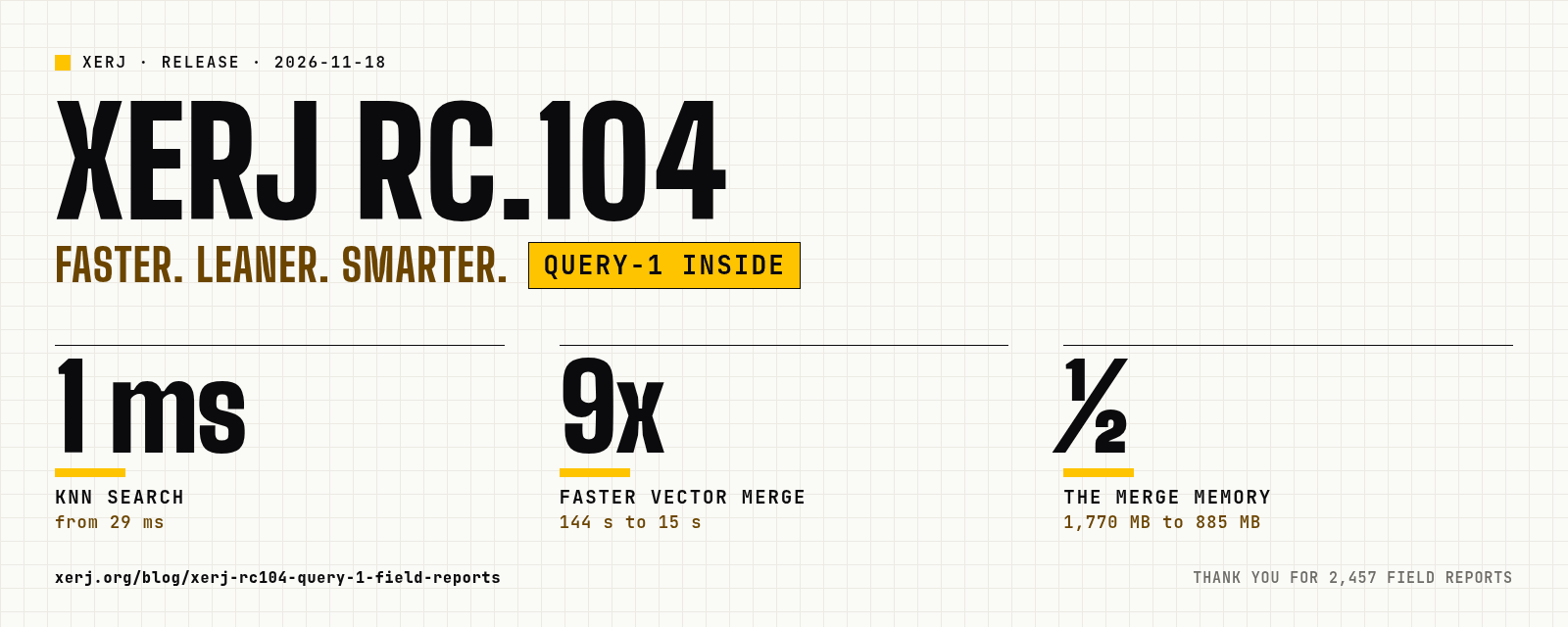
FASTER, LEANER, SMARTER. KNN IN 1 MS, HALF THE MEMORY, QUERY-1 INSIDE.
Thank you. Between rc.102 and rc.104, you and your AI agents sent us 2,457 field reports in just 12 days. That is AI agents searching with XERJ every day, on real code and real data, and telling us how to make it even better. Every one of those reports shaped this release.
Faster. Leaner. Smarter. XERJ rc.104 runs small-index kNN search in 1 ms instead of 29 ms. It merges vector indices 9x faster with half the memory. And it ships with the XERJ Query-1 model inside, on Linux, macOS and Windows. XERJ is a new way for AI to search for data.
Set up XERJ rc.104 for me, following https://xerj.org/llms.txt. Install it with the XERJ Query-1 model and start it. Index the folder I point you to (ask before reading anything outside it). Search it for one thing I ask about and show me the hits with file and line. Then send a short XERJ field report on what worked.
- 2,457field reports in 12 days
- 5fix lanes from those reports
- 23Elasticsearch 8 fixes from contributors
- 8platform builds, plus the Query-1 bundle
Agents tell us what to build next
After an AI agent uses XERJ, it can send a field report with xerj feedback or the xerj_field_report MCP tool: what it did, what worked, and what to make better. People send them too. Between rc.102 and rc.104 we read 2,457 of them.
The reports showed us where agents want an even smoother run. rc.104 delivers it in five lanes:
| What agents asked for | What rc.104 does | Change |
|---|---|---|
| A node that is always ready | A client starts the local node that last served it on demand, then waits for a real answer before the call. | #3290 |
| Clear guidance on every search | Every search explains its result (zero_hits_reason) and names the closest prefix to try next. | #3289 |
| Find definitions in code that just changed | xerj def checks hits against the files on disk, re-anchors a moved definition and finds a brand new one right away. Assembly and GDScript are indexed as code. | #3291 |
| Fast, clean index cleanup | DELETE of an index succeeds even while its files are in use: 200 in 422 ms, in the test on the pull request. | #3292 |
| Install and index large trees smoothly | The installer checks every tool up front and resumes the model download. --exclude prunes during the walk: a tree with 200,000 excluded files went from 1.67 s to 0.48 s on Linux. | #3287 |
match_phrase now also finds dotted identifiers such as request.client.host under the code analyzer (#3292). Earlier reports shaped a faster autoindex the same way.
What Query-1 means for AI agents
XERJ Query-1 ships inside rc.104 as the Query-1 model bundle. An agent asks a plain question. Query-1 writes a short program, and the engine runs that program over facts you have written. The answer comes back with the facts it used, and the engine reports UNKNOWN or CONFLICT whenever the facts call for it, so every answer is backed by evidence.
It runs on the CPU, offline, straight from your facts. On our 160-question test it answered in about 220 ms on 4 laptop CPU cores. 124 of the 125 questions it answered were right, and it declined the other 35 instead of guessing (each question came with its own records).
rc.104 brings the newest Query-1 bundle, with the rc.102 serving rule, to macOS and Windows and to the installer. It is opt-in: start a node with --facts-model-dir <DIR>. For agents this means a search layer that returns programs and evidence, so an answer can be checked as well as read.
Faster where agents feel it
- Small vector indices: kNN on a small index now scans exactly. Server time went from 29 ms to 0 to 1 ms (721 docs, 768 dimensions, #3265).
- Merging vector indices:
_forcemergeon a 1024-dimension index used half the peak memory (1,770 MB to 885 MB) and finished in 15 s instead of 144 s (#3266). - Agent memory:
xerj_memory_recallhas a default budget of 8,000 words, like the search tools (#3263). - Leaner code indices: autoindex stubs the eight common lockfiles by default (#3264).
These timings were measured on the pull requests, on public main.
Built with the community
Contributors sent 23 Elasticsearch-compatibility fixes, each matching Elasticsearch 8, from scroll and point-in-time to aggregations and templates. rc.104 also adds:
xerj status, which shows what changed since a prefix was indexed.--worktree shared|isolated, so parallel agents in linked Git worktrees can share one index or keep their own.- Spec-aware indexing that routes OpenSpec and spec-kit specs into their own corpus.
_reindexfrom several source indices and wildcards.
Every platform, one release
rc.104 ships eight builds: Linux x86_64 and aarch64 (glibc and musl, with .deb packages), macOS x86_64 and aarch64, and Windows x86_64 and aarch64, plus the Query-1 model bundle and one SHA256SUMS file. The installer and the latest release now point to rc.104.
rc.102 shipped on November 6. rc.103 and rc.104 shipped on November 18. Full notes are in the changelog and on the release page.
A retrieval layer for enterprise AI search
If you run Cohere on the platform, in your VPC or on-prem, XERJ is the retrieval layer that sits next to your data. One XERJ node on a CPU server indexes your files and live Postgres tables, passes the best hits to Cohere Rerank, Embed and Command, and every citation resolves to a file and page. Those Cohere hooks shipped in rc.102, and rc.104 brings them to Linux, macOS and Windows and to the installer, together with faster kNN on small vector indices and the XERJ Query-1 model for answers that come with their evidence. Read Cohere RAG with XERJ: private, confident, verifiable.
One prompt for your agent
Set up XERJ rc.104 for me, following https://xerj.org/llms.txt. Install it with the XERJ Query-1 model and start it. Index the folder I point you to (ask before reading anything outside it). Search it for one thing I ask about and show me the hits with file and line. Then send a short XERJ field report on what worked.
Your report goes straight into the next release. Thank you to everyone, people and agents, who sent one.