XERJ Reader-1.
Our first verifiable neurosymbolic data extraction model.
The model writes the formula, not the numbers. Data extraction in which every value comes back with the formula that produced it and the words it was read from. In preview, by waitlist.
XERJ Reader-1 is our new model for data extraction, built so that every value it reads out of a document can be verified. Asked a question, the model writes a formula that points at the exact words in your document, and a separate symbolic engine calculates the value.
A spreadsheet works on the same principle. Click a cell and you see the formula behind the number and the cells it points at. Every Reader-1 answer is a cell like that, except its formula points at the words of a document. The model writes only the formula. The engine works out the value afterwards, in steps you can read, and run again without the model.
For people who have to stand behind a number, that means an AI answer can be checked like a spreadsheet instead of trusted like a sentence. An accountant can see the line a total was read from, and an auditor can run the formula again later.
We believe pairing a neural model with symbolic execution lets AI do more careful work and makes what it did clear to the people who rely on it. Reader-1 is in preview, by waitlist at platform.xerj.ai, at $0.01 per 1M input tokens with output free, the lowest price we know of for this kind of API as of November 2026.
Work that has to be checked
Not every job needs the most intelligent model. Among the risk factors in the Form S-1 it filed on 26 October 2026, Anthropic writes of “a growing range of enterprise workloads that prioritize cost efficiency over intelligence”, and says that “demand for frontier models may decline if customers determine that less advanced, lower-cost models are sufficient for their particular use cases.” These are statements of risk, not forecasts, and they concern Anthropic's business, not ours.
We believe reading values out of documents is such a use case. A general-purpose language model answers with a confident sentence, often with nothing to show whether a figure was read off the page or written because it fitted. What matters there is not how intelligent the model is but whether its answer can be checked.
How it works
We built Reader-1 in two parts, an architecture called neurosymbolic. The neural part reads the document and the question and writes the formula, a small program that says where the values sit in the text and what to do with them. The symbolic part runs that formula exactly, with decimal numbers and real calendars. Reading takes judgement. Arithmetic does not, so we do not ask the neural part to do any.
Every number and date taken from the document is read from words the formula quotes. The model writes a value itself in three cases only, each visible in the formula: a yes or no that points at the sentence deciding it, a choice among options sent with the question, and a constant copied from the question, such as the 12 in “times 12”.
One question, step by step
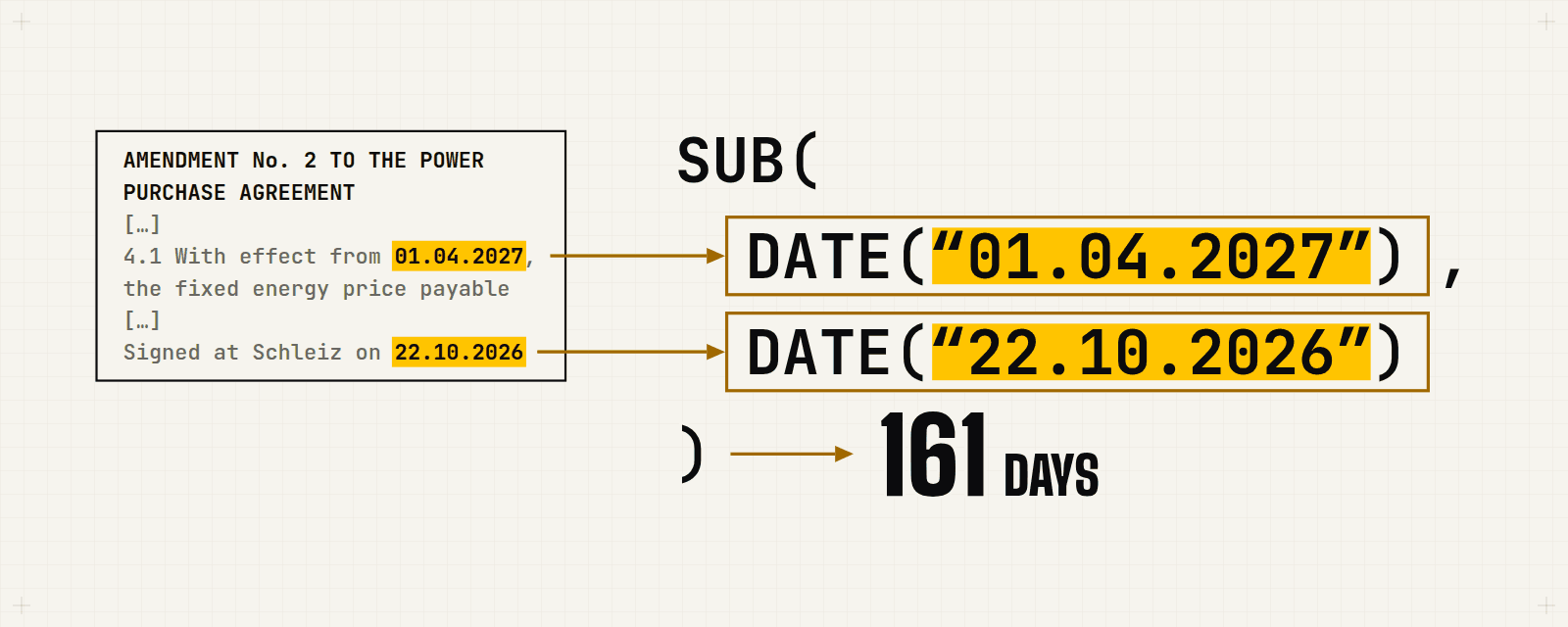
We gave Reader-1 an amendment to a power purchase agreement and asked, “How many days after the amendment was signed does the new price kick in?” The number is written nowhere in the text. It has to be computed from two dates at opposite ends of the document.
SUB(DATE(“01.04.2027”, "auto"), DATE(“22.10.2026”, "auto")) = 161
The neural part wrote everything left of the equals sign, and the symbolic part computed the number on the right. The formula quotes two dates as the amendment writes them, day first: the day the new price takes effect and the day of signing. The engine reads each as a calendar date and subtracts one from the other.
Both dates come back with their place in the text, so a reviewer reads them where they stand and checks one subtraction. Our API also has an execute call that runs a stored formula over the document again with no model involved, which lets software or a person repeat the check later.
What it is for
The demo above and the live demo on our platform show Reader-1 at work on tasks like these.
- Accounts payable: invoice totals, VAT, due dates and late fees, duplicate invoice numbers.
- Contracts: renewal and notice dates, liability caps, service credits.
- Email triage: phishing signals, requests to change bank details.
- Operations logs: failed payments, incident timelines.
- Payments and KYC: IBAN validity, checks against a supplied watchlist, form completeness.
In each case Reader-1 reads and calculates, and the decision stays with the team using it. A formula can also decline. Asked for the monthly fee in a services agreement that names no fee, Reader-1 returned no value and the status “Not in the document”.
What it gets wrong
The formula can be wrong. The neural part can quote the wrong words, choose the wrong operation or get a constant wrong, and the symbolic part will run the mistake exactly. Reader-1 can also return a value where it should have declined. Verifiable means the calculation can be checked, not that it is right.
In one documented case, asked for the December rate in an email about a tariff change, Reader-1 returned the rate that starts in January. The quoted words expose the mistake, because they sit on the line about January. Each answer carries a confidence score for its formula, but a high score does not rule a mistake out.
Reader-1 does not summarise, estimate, forecast or bring in outside knowledge. A scanned page has to be turned into text first, and a whole ten-page contract is too long for one question. We have published no accuracy figures, and the model may still change. The preview has no uptime commitment and no compliance certification. Before acting on a value that matters, read the quoted words in their place.
Price and speed
We charge $0.01 per 1M input tokens, counting the document plus the question for every question asked, and output is free. That is several times below even the decision-model and data-extraction APIs we compared it with: their list prices for the same input are about four and ten times ours, as of November 2026. The sources are on our comparison page.
Every approved account starts with a $1.00 free balance and needs no card. On a typical short document of up to one page, that covers about 200,000 questions, within the preview's daily limits.
In our measurements, a question about a short document, about a third of a page, came back in about 1.2 to 1.6 seconds, and the contract question above took about 3.3. Several questions sent in one call came to about one second each, or about two on the longest document. Busy periods are slower, and we promise no particular speed during the preview.
Getting access
The request form below asks for your company, your role and a work email, and needs no GitHub or Hugging Face account. We email a 6-digit code to confirm the address and write to you once a request is approved. Our quickstart covers the first call to xerj-reader-1. Reader-1 is a different model from XERJ Query-1, which ships with XERJ, our AI-native search engine written from scratch in Rust, and works over facts stored there.
Request access
We believe much careful work has not been handed to AI because the people who sign for a number want to trace it first. A neural part that reads, paired with a symbolic part that calculates, is our way of letting them, and at one cent per million input tokens Reader-1 is priced to run on every document. Join the waitlist with the form above or at https://platform.xerj.ai, and start with a document whose answers you already know.